Many of the historical medical, anatomical, and botanical illustrations used throughout this site are drawn from public collections. We gratefully credit each source below.
Wellcome Collection
The following images are courtesy of the Wellcome Collection, London.

Illustration showing bodily tracks and their acupuncture points
Illustration showing bodily tracks and their acupuncture points. One of three large sheets prepared by Okamoto Ippo. Wellcome Collection. Attribution 4.0 International (CC BY 4.0). Source: Wellcome Collection.

Daoyin tu — chart for leading and guiding people in exercise
Daoyin tu – chart for leading and guiding people in exercise for improving health and treatment of pain, containing animal postures such as bear walk. This is a reconstruction of a ‘Guiding and Pulling Chart’ excavated from the Mawangdui Tomb 3 (sealed in 168BC) in the former kingdom of Changsha. The original is in the Hunan Provincial Museum, Changsha, China. Wellcome Collection. Attribution 4.0 International (CC BY 4.0). Source: Wellcome Collection.
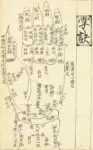
Qing Chinese paediatric palm massage chart
Qing Chinese paediatric palm massage chart. Wellcome Collection. Attribution 4.0 International (CC BY 4.0). Source: Wellcome Collection.
Chinese C18 woodcut: External medicine — Haemorrhoids
Chinese C18 woodcut: External medicine – Haemorrhoids. Wellcome Collection. Public Domain Mark. Source: Wellcome Collection.
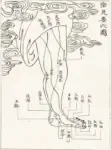
Acupuncture points and meridians: the foot
Acupuncture points and meridians. The foot taken from I-tsung chiu-chien, ‘The Golden Mirror of Medicine’ a compendium of medical works edited by Wu Chien and first published in 1742. Wellcome Collection. Attribution 4.0 International (CC BY 4.0). Source: Wellcome Collection.

Acupuncture points and meridians: the arm
Acupuncture points and meridians. The arm. Wellcome Collection. Attribution 4.0 International (CC BY 4.0). Source: Wellcome Collection.
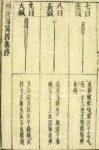
The nine ancient acupuncture needles (17th century Chinese)
The nine ancient acupuncture needles, 17th Chinese (detail). Wellcome Collection. Public Domain Mark. Source: Wellcome Collection.
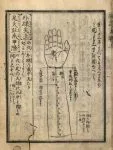
Acu-moxa chart: points of the hand and arm (Japanese woodcut)
Acu-moxa chart: points of the hand and arm, Japanese woodcut. Wellcome Collection. Public Domain Mark. Source: Wellcome Collection.

Chinese Materia Medica (17th century): Lychee
Chinese Materia medica, C17: Plant drugs, Lichee. Wellcome Collection. Public Domain Mark. Source: Wellcome Collection.
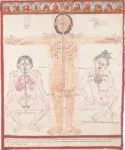
Three Tibetan anatomical figures
Three Tibetan anatomical figures. Watercolour, 1904. Wellcome Collection. Attribution 4.0 International (CC BY 4.0). Source: Wellcome Collection.
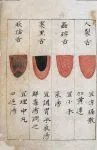
C14 Chinese tongue diagnosis chart
C14 Chinese tongue diagnosis chart. Wellcome Collection. Public Domain Mark. Source: Wellcome Collection.
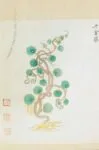
Ming herbal (painting): Stephania
Ming herbal (painting): Stephania. Wellcome Collection. Public Domain Mark. Source: Wellcome Collection.
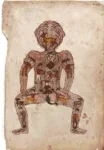
The zodiac man
The zodiac man. Watercolour painting by a Persian artist. Wellcome Collection. Public Domain Mark. Source: Wellcome Collection.
Wikimedia Commons

內景全圖 (Nei Jing Tu / “Interior Complete View”)
From the Gujin Tushu Jicheng (Imperial Encyclopaedia), compiled by Chen Menglei, c. 1700–1725. Wikimedia Commons. Public domain.
